
House of the Scales
History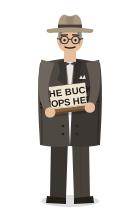
Harry S. Truman
The buck stops here · 1884–1972
Where you meet them
Their story is still ahead in Moralia.
A Farm, a Battery, a Shop
He grew up in Missouri and worked his family's farm for more than ten years. In the First World War he commanded an artillery battery in France. Afterward he opened a men's clothing store in Kansas City with an army friend; it failed in the slump of 1921 and 1922, and he spent years paying off the debts. A Kansas City political machine run by Tom Pendergast backed him for county office and then, in 1934, for the Senate, where he made his name investigating waste in defense contracts. Roosevelt chose him as his running mate in 1944. As president he approved the atomic bombings of Japan, signed the Marshall Plan to rebuild Europe, ordered the armed forces desegregated and sent troops to Korea. In 1948 he won an election that nearly every poll had given away.
Home to Independence
He left office in 1953 and went home to Independence, Missouri, with no presidential pension and no Secret Service protection, and that summer drove himself and his wife Bess across the country. He turned down paid positions he thought would trade on the presidency. Congress gave former presidents a pension in 1958, partly because of his circumstances. He died in a Kansas City hospital on December 26, 1972, aged eighty-eight, and was buried in the courtyard of his own presidential library.
"The buck stops here."
The motto on a sign on his Oval Office desk, a gift in 1945 from a friend, the U.S. Marshal for western Missouri. Not his own coinage; he made it his own, saying in his farewell address of January 1953 that the president "has to decide. He can't pass the buck to anybody."
Play today's story