House of the Storm
History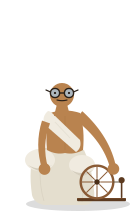
Mahatma Gandhi
The means are the end · 1869–1948
Where you meet them
Thrown Off a Train in South Africa
He was a London-trained barrister who was thrown off a train in South Africa in 1893 for refusing, as an Indian, to give up his paid first-class seat, and stayed twenty-one years developing what he called satyagraha — organized, disciplined, public refusal to cooperate, absorbing the violence rather than returning it. He returned to India in 1915 and spent thirty years turning the Indian National Congress from a party of lawyers into a mass movement, mostly by making its arguments physical: boycott British cloth and spin your own instead, walk to the sea. In 1930 he walked three hundred and eighty-five kilometers in twenty-four days to pick up a handful of salt from a beach, because salt was taxed and every poor person in India used it. Around sixty thousand people were arrested in what followed. Independence took seventeen more years of campaigns like it before Britain finally left in 1947.
Fasting in Calcutta, Not Celebrating
He was not at the independence celebrations. He was in Calcutta, fasting, trying to stop Hindus and Muslims killing each other during Partition, when British India split into India and Pakistan and millions crossed the new border — and it worked well enough that Britain's last viceroy called him a one-man boundary force. On 30 January 1948, walking to a prayer meeting in Delhi, he was shot three times by a Hindu nationalist who believed he had been too accommodating to Muslims. He was seventy-eight.
"The means may be likened to a seed, the end to a tree."
— Hind Swaraj, 1909, written in his own hand on a ship — the opening clause of a longer sentence. Documented. Note: "Be the change you wish to see in the world" is not his — see the misattribution table.
Play today's story