
House of the Flame
History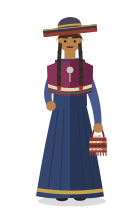
Micaela Bastidas
The rebellion's governor · 1744–1781
Where you meet them
Their story is still ahead in Moralia.
A Girl From Pampamarca
Micaela Bastidas Puyucahua was born on June 23, 1744, at Pampamarca, in the province of Tinta, south of Cuzco. Her father died when she was a small child, and she grew up poor. In some documents of her time she is called a zamba, a word for a person of mixed African and Indigenous descent. In 1760, before her sixteenth birthday, she married José Gabriel Condorcanqui, a cacique, or Indigenous local lord, who ran mule trains and claimed descent from the last Inca ruler. They had three sons, Hipólito, Mariano and Fernando, and she was his partner in business long before she was his partner in revolt. In November 1780 he rose against Spanish rule under the name Túpac Amaru, and she ran the rebellion's supplies, money, weapons and messengers from their home at Tungasuca.
The Main Square of Cuzco
In April 1781 the rebellion was defeated, and she was captured with her husband and their sons. The Spanish official who judged them, José Antonio de Areche, refused her any pardon. On May 18, 1781, in the main square of Cuzco, she was executed with her husband and her son Hipólito. She was thirty-six. Peru now honors her as a heroine of its independence.
"I have no patience left to bear all this."
From her letter to Túpac Amaru of December 6, 1780 (Loayza, Mártires y heroínas, 1945, pp. 48-51), as transcribed in Sara Beatriz Guardia, ed., Micaela Bastidas (2019). The translation is Moralia's.
Play today's story