House of the Storm
Legend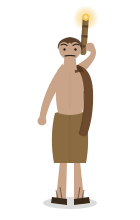
Prometheus
He knew the price · Hesiod c. 700 BC; Aeschylus 5th c. BC
Where you meet them
Their story is still ahead in Moralia.
Twice for a Species Not His Own
Prometheus has no life outside the poems. He is a Titan in Hesiod's Theogony, written around 700 BC, and the central figure of Aeschylus' Prometheus Bound roughly two and a half centuries later. Though a Titan himself, he had backed Zeus, the king of the gods, in the war against the other Titans, the older gods Zeus's generation overthrew, and then twice took the side of humanity against Zeus himself: once by rigging a sacrifice so the gods, tricked by appearances, chose the bones and humans kept the meat, and then, when Zeus responded by withholding fire, by stealing it. In Aeschylus the theft is much larger than fire. He gives humans number, writing, medicine, the reading of the seasons and the taming of animals — and, he says, blind hopes — so that not knowing the exact day they would die, people could still get up and live the days they had left.
An Eagle, Every Day
He does not get a death. He is immortal, and the punishment rests on that: chained to a rock in the Caucasus with an eagle at his liver every day, for as long as there are days. Aeschylus has Hermes tell him plainly that it ends the moment he gives up what he knows — which of Zeus's future children will overthrow him, as Zeus overthrew his father, Cronus — and he refuses, and Hermes leaves. Generations later the hero Heracles, known as Hercules, shoots the eagle, and Zeus, who by then wants the secret, allows it. Nothing about the sentence required it to end.
"In one short sentence: every art of mankind came from Prometheus."
— Aeschylus, Prometheus Bound, c. 5th c. BC, spoken by Prometheus himself. Public domain; wording varies by translation.
Play today's story