
House of the Flame
History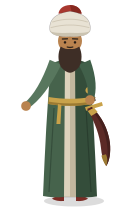
Saladin
The sultan who gave everything · c. 1137–1193
Where you meet them
Their story is still ahead in Moralia.
A Kurd From Tikrit
Yusuf ibn Ayyub, called Salah ad-Din, 'the righteousness of the faith', was born around 1137 at Tikrit, in today's Iraq, into a Kurdish family of soldiers. He rose in the service of Nur ad-Din, the ruler of Syria, and went with his uncle Shirkuh on the campaigns that won Egypt. In 1169 he became vizier of Egypt, and in 1171 he ended the Fatimid caliphate that had ruled it for two centuries. Over the following years he brought Egypt and Syria under his own rule as sultan. In July 1187 he destroyed the crusader army at Hattin. Afterward he fought the Third Crusade, led by King Richard I of England, to a standstill, and in 1192 the two sides agreed a truce. His secretary, Baha ad-Din, wrote that he gave away whole provinces, and that his treasurers hid money from him, knowing he would spend it at once.
Forty-Seven Pieces of Silver
In February 1193, in Damascus, he fell ill with a fever. Baha ad-Din, who sat with him, recorded his decline, and his death on 4 March 1193. He was about fifty-five. His secretary also recorded what he left: forty-seven silver dirhams and a single gold piece. There was no house, no land, no garden and no village. He was buried in Damascus, beside the Umayyad Mosque.
"It may be that there is someone in the world who esteems money of as little value as the dust of the earth."
Words of his recorded by his secretary, Baha ad-Din, who took them to be about Saladin himself. From C. W. Wilson's translation, The Life of Saladin (Palestine Pilgrims' Text Society, 1897).
Play today's story