House of the Oath
History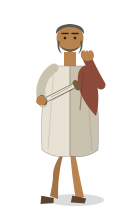
Aristotle
Virtue is a habit · 384–322 BC
Where you meet them
Their story is still ahead in Moralia.
Twenty Years, Then Disagreed
Born at Stagira in 384 BC, the son of a doctor. He spent twenty years studying under the philosopher Plato at Plato's Academy, and then disagreed with almost all of what his teacher taught him. He tutored the boy who became Alexander the Great, and in 335 BC founded his own school in Athens, the Lyceum. He wrote on logic, physics, biology, poetry, rhetoric, politics and ethics, and for nearly two thousand years he was simply "the Philosopher." His moral position is unglamorous and durable: virtue is not a feeling or a rule but a habit, built by repetition, and it sits between two failures — courage between cowardice and recklessness, generosity between meanness and waste. You become good by practicing being good, the way you become a builder by building.
The Same Charge That Killed Socrates
When Alexander died in 323 BC, Athens turned on anything Macedonian — and Aristotle, who had tutored the Macedonian king's son and kept close ties to that court, counted as exactly that. Aristotle was charged with impiety, the same charge that had killed the philosopher Socrates, Plato's own teacher, decades before. He left the city — reportedly saying he would not let Athens sin twice against philosophy — and died at Chalcis the following year, aged sixty-two, of natural causes. He chose exile over the martyrdom that had made Socrates immortal.
"Moral virtue comes about as a result of habit."
— Nicomachean Ethics II.1. Public domain. Note: the far more famous line "we are what we repeatedly do; excellence, then, is not an act, but a habit" is not Aristotle — it is Will Durant's 1926 paraphrase. Do not ship it as a quotation.
Play today's story