House of the Scales
History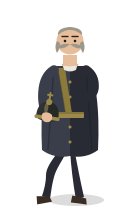
Otto von Bismarck
Iron and blood · 1815–1898
Where you meet them
Three Wars in Seven Years
Otto von Bismarck was born in 1815 into the Prussian country gentry and was made minister-president of Prussia in 1862 to break a budget deadlock, telling the parliament that the great questions of the age would not be settled by speeches and majority votes but by iron and blood. He then fought three short wars in seven years — Denmark, Austria, France — winning each of them, and ended each one before it could become a general European war, including refusing to march on Vienna when he could have. In January 1871 the German Empire was proclaimed in the Hall of Mirrors at Versailles — French soil, chosen for the insult — and Wilhelm I became its first Kaiser. He spent the next twenty years preserving what he had made, through a system of alliances that only he could hold in his head. He outlawed the Socialist Party, then gave the world its first national health insurance, accident insurance and old-age pension, so that working men would have less reason to listen to it.
Forced Out by the Young Kaiser
The young Kaiser Wilhelm II, Wilhelm I's grandson, forced his resignation in 1890, two years after inheriting the throne. He spent eight years at Friedrichsruh writing his memoirs and attacking the government in the press, and died there on 30 July 1898, aged eighty-three. He had specified his own tomb inscription: a loyal German servant of Emperor Wilhelm I. The empire he assembled outlived him by twenty years.
"Politics is the art of the possible."
— Remark to Friedrich Meyer von Waldeck, 11 August 1867, printed in the St. Petersburgische Zeitung. No verbatim first-hand record survives; the German is usually given as "Die Politik ist die Lehre vom Möglichen" — nearer to "politics is the science of the possible."
Play today's story